Following the decommissioning of the Payconiq brand in Belgium, these URL changes are essential to ensure compliance and mark the final phase in aligning our branding with the new Bancontact Pro identity.
Please implement adaptations described here promptly to avoid service interruptions and guarantee the continued acceptance of mobile payments via Bancontact Pay and Wero.
Changes are already available in our pre-production environement and will be rolled out in production starting 11/05/2026
On a Display allows you to generate a one-time usage digital QR code and show it on a consumer-facing screen. Your consumers scan the QR code with their preferred payment application and confirm the transaction.
The following section outlines the key steps involved in a "On a Display" Instore payment with Bancontact Pro. The process involves several key parties, each playing a specific role in completing the transaction.
- API Key – This is used to secure the request between the Merchant’s backend and Bancontact Pros backend. Do not share your API keys in public areas such as online sites or client-side code.
- Merchant CallbackUrl (Optional) – This URL will be called by Bancontact Pro's backend servers in order to send the status of the payment to the merchant.
The following parties participate in a display-based in-store payment with Bancontact Pro:
- Payer Application: The consumer's preferred payment app used to complete the transaction.
- Merchant Frontend: The consumer-facing screen (e.g., POS or tablet) where the QR code is displayed.
- Merchant Backend: The merchant’s server-side system that integrates with Bancontact Pro.
- Bancontact Pro's Backend: The backend system responsible for handling payment processing and integration services.
This section outlines a typical “On a Display” in-store payment flow using Bancontact Pro. The process begins when the transaction is initiated at the merchant’s location and ends when both the merchant and the consumer receive the final confirmation.
On a Display can be used with or without the "Void Functionality". Void is an intermediary step that allows your backend to remain in the lead of a payment transaction after your consumer has confirmed the payment.
With Void, you will be required to individually acknowledge each payment within a maximum of seven (7) calendar days. If a payment is voided, your consumer will be automatically refunded.
Important Note: in case Void is required, it should be specified upon contract signature. The functionality needs to be activated by our Support Team.
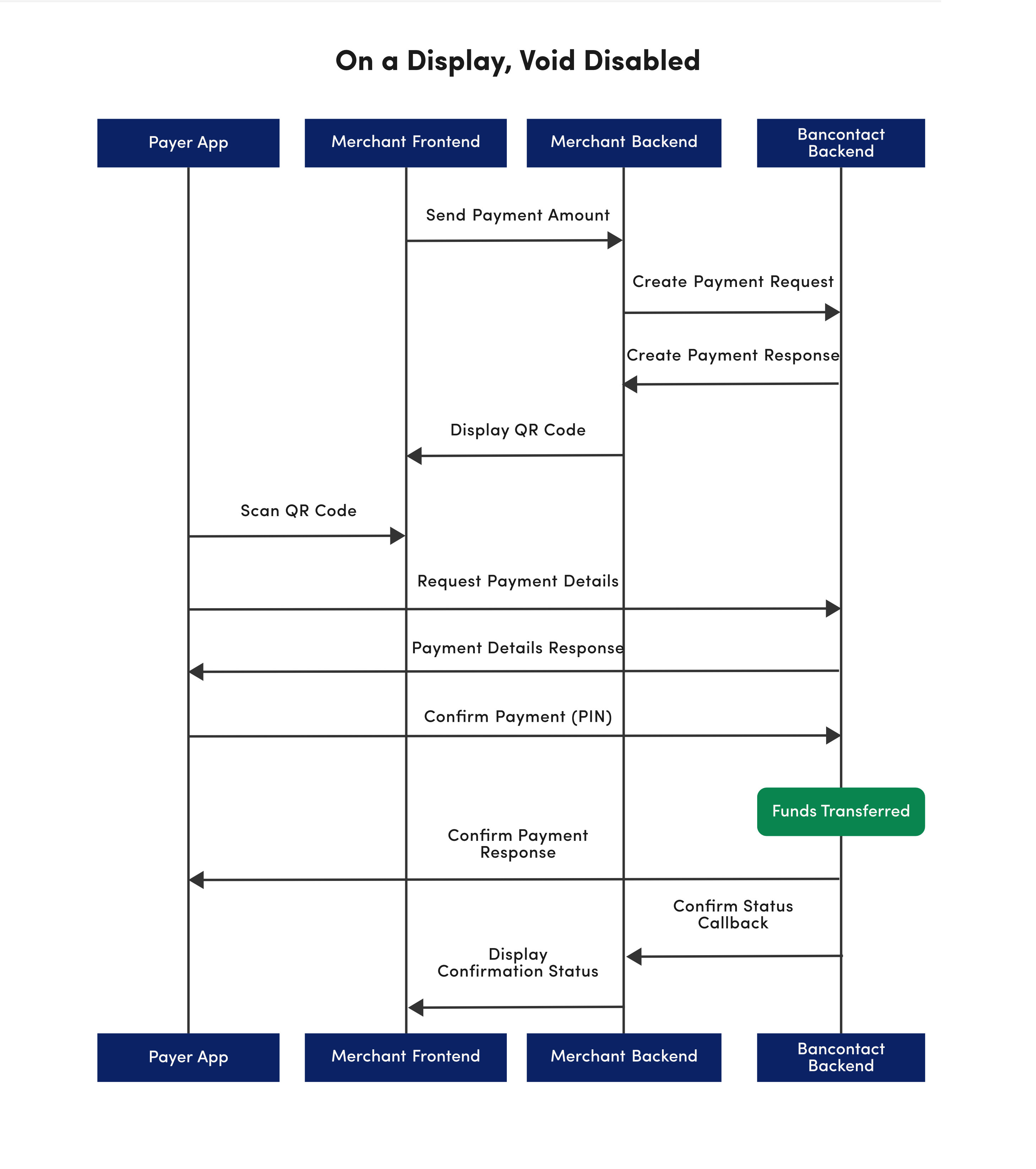
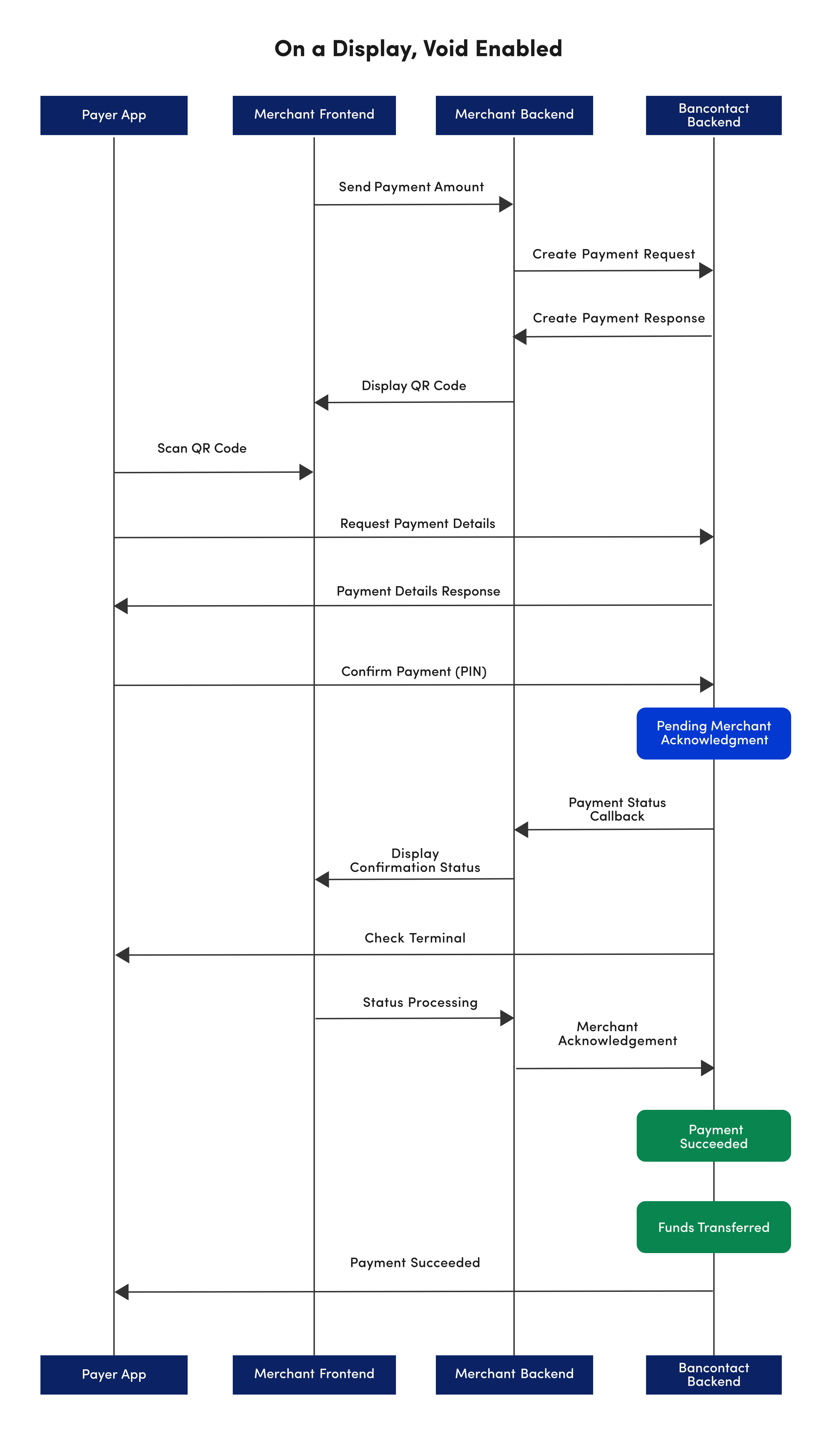
The initial steps are identical whether the Void feature is enabled or disabled. Differences between the two flows are clearly presented in the comparison table that follows.
- The merchant frontend sends payment creation details to the merchant backend. Request should at least contain the payment amount.
- The merchant backend issues a REST request to the Bancontact Pro backend to create the payment, providing parameters like amount, currency, description, and other relevant parameters.
- The Bancontact Pro backend responds with the created payment ID and other relevant details, including a unique QR code URL.
- The merchant backend forwards the QR code URL to the merchant frontend, which displays it for the consumer.
- The Payer app scans the QR code and sends a request to retrieve payment details from the backend.
- The Bancontact Pro backend sends payment details to the Payer App, including merchant name and amount to pay.
- The consumer confirms the payment using PIN, fingerprint, or face ID. The app then submits the payment request to the backend for authorization.
| Void Disabled | Void Enabled |
|---|---|
| A payment response is sent back to the Payer App, indicating whether the payment was successful or failed. | The consumer is debited, and the payment enters a PENDING_MERCHANT_ACKNOWLEDGEMENT state, awaiting confirmation from the merchant backend. |
| The Bancontact Pro backend sends a payment notification with the payment status to the merchant backend via the configured callback URL. | The Bancontact Pro backend sends a callback to the Merchant backend with the payment status. The merchant can also poll for updates. |
| The merchant frontend displays the payment confirmation status. | The consumer is prompted in the app to check the consumer-facing screen for the final payment status. |
| — | The merchant backend sends a positive acknowledgment to indicate successful processing. |
| — | The Bancontact Pro backend marks the payment as SUCCEEDED and initiates a payout to the merchant. |
| — | The merchant frontend displays the final confirmation to the consumer. |
| — | The Payer App notifies the consumer of the final payment outcome. |
Important Note: The order in which the merchant and consumer receive payment status notifications is not guaranteed. Network and connectivity differences may cause one party to receive the update before the other.
In the following diagrams you will find a visual overview of the process flows presented above:
Please follow the below steps to successfully implement "On a Display" on your or consumer facing display.
For the full endpoint documentation, please refer to the Merchant Payment API.
In order to initiate a payment, you will first have to create it through Bancontact Pro via a POST request. Each request will result in a unique payment identifier which will be valid for two minutes (120 seconds).
If the payment does not take place within these two minutes, a new payment must be created.
Important Note: for On a Display the returnURL is not necessary.
Merchant payment reference, used to reference the Bancontact Company payment in the merchant's system. The characters used must comply with the SEPA Requirements for an Extended Character Set (UNICODE Subset) - Best Practices | European Payments Council.
Field used to reference a bulk batch, so the merchant can inform how the payments should be bulked. If it's not set here it will default to the one configured in the profile.
Amount in cents requested
Description of the payment that will be shown to the debtor, also used in the bank statement for reconciliation purposes. The characters used must comply with the SEPA Requirements for an Extended Character Set (UNICODE Subset) - Best Practices | European Payments Council.
Callback url to which merchants will be notified about the payment identification. If it's not set here it will default to the one configured in the profile
callbackUrl to which the merchant will be notified about the payment payout. If it's not set here it will default to the one set in the profile
Merchant return url to which the dynamic payment page will redirect after the payment is completed
List of Value Added Services (vouchers) eligible amounts within the payment
Important Note: for On a Display the checkout link will not be provided in the response.
Payment ID
the status of the payment created
the creation time of the payment
the time from which the payment will be expired
Description of the payment that will be shown to the debtor, also used in the bank statement for reconciliation purposes. The characters used must comply with the SEPA Requirements for an Extended Character Set (UNICODE Subset) - Best Practices | European Payments Council. Only first 35 characters will be used for the remittance info
Merchant payment reference, used to reference the Bancontact Company payment in the merchant's system. The characters used must comply with the SEPA Requirements for an Extended Character Set (UNICODE Subset) - Best Practices | European Payments Council.
Amount in cents requested
Currency code. Only EUR is supported ISO 4217
Creditor account set to receive the payment
The configuration ID of the Merchant
the Id of the merchant
Merchant's company name that will be shown to the debtor
Creditor's Bank Account Iban to where the money will be sent to for this current payment
callbackUrl to which the merchant will be notified about the payment identification
callbackUrl to which the merchant will be notified about the payment payout
Provides information to navigate to our REST interfaces dynamically, by including hypermedia links to them. Note that for some links inclusion depends on the status of the payment (e.g. cancel link will be available on PENDING and refund on SUCCEEDED)
| HTTP Status | Code | Meaning |
|---|---|---|
| 400 | BODY_MISSING | A json needs to be provided |
| 400 | FIELD_IS_REQUIRED | Field X is mandatory |
| 400 | FIELD_IS_INVALID | Field X is invalid |
| 401 | UNAUTHORIZED | user does not have an access token |
| 403 | ACCESS_DENIED | The JWT could not be verified (different format) - The JWT does not contain the required authority to access the resource requested |
| 404 | MERCHANT_PROFILE_NOT_FOUND | The merchant profile does not exist |
| 422 | UNABLE_TO_PAY_CREDITOR | Variable reason(Depends on automatic processing). |
| 500 | TECHNICAL_ERROR | Technical error in Payment service |
| 503 | TRY_AGAIN_LATER | one of the internal services is unavailable |
- PREPROD merchant APIhttps://merchant.api.preprod.bancontact.net/v3/payments
- PROD merchant APIhttps://merchant.api.bancontact.net/v3/payments
- curl
- JavaScript
- Node.js
- Python
- Java
- C#
- PHP
- Go
- Ruby
- R
- Payload
curl -i -X POST \
  https://merchant.api.preprod.bancontact.net/v3/payments \
  -H 'Authorization: YOUR_API_KEY_HERE' \
  -H 'Content-Type: application/json' \
  -d '{
    "reference": "19848995",
    "bulkId": "Bulk-1-200",
    "amount": 1,
    "currency": "EUR",
    "description": "string",
    "identifyCallbackUrl": "https://api.merchant.bancontact.net/identify",
    "callbackUrl": "https://api.merchant.bancontact.net/payment",
    "returnUrl": "https://api.merchant.bancontact.net/payment",
    "voucherEligibility": [
      {
        "voucherSchemes": [
          "BEL_MEAL_VOUCHER"
        ],
        "amount": 1013
      }
    ]
}'To display the Bancontact Pro QR code, you can render the URL from the attribute _links.self.href received in the Create Payment response in a web view. By doing so, you will make use of Bancontact Pro's QR code generation service and will generate by default a small QR code (cf. Brand Guidelines).
Important: the format, size and colour of the QR code can be modified if necessary using the parameters below. Please make sure to read our Brand Guidelines for more guidance on the minimum sizes and scanning distances.
| Attribute | Description |
|---|---|
f [String :: Enum] Allowed Values: SVG, PNG | Image format |
s [String :: Enum] Allowed Values: S, M, L, XL | Image size of the QR code to generate. Small (S) = 180x180 Medium (M) = 250x250 Large (L) = 400x400 Extra Large (XL) = 800x800 The sizes only applies to PNG format. |
You can specify a callback URL where the Bancontact Pro backend will send notifications about the status of a payment. This will allow you to take appropriate action and process the payment data.
The merchant backend must verify that the notification message originated from Bancontact Pro backend was not altered or corrupted during the transmission. To do so, please ensure signature validation.
For the full Callback documentation, please refer to the Callback Guide.
Bancontact Company Payment ID
Only EUR is supported currently
Requested amount in cents
Description of the payment that will be shown to the debtor, also used in the bank statement for reconciliation purposes. The characters used must comply with the SEPA Requirements for an Extended Character Set (UNICODE Subset) - Best Practices | European Payments Council.
Merchant payment reference, used to reference the Bancontact Company payment in the merchant’s system. The characters used must comply with the SEPA Requirements for an Extended Character Set (UNICODE Subset) - Best Practices | European Payments Council.
When the payment was created
When the payment is going to expire. After that date the payment can't be confirmed anymore
if the payment is SUCCEEDED, then this field represents the date-time on which the payment was SUCCEEDED
| Status | Description |
|---|---|
| PENDING | The merchant has created the payment and and is pending to proceed with identify step. |
| IDENTIFIED | The user has scanned the payment's QR code with the Bancontact Pay. |
| AUTHORIZED | The user has confirmed the payment and the bank authorized it. |
| AUTHORIZATION_FAILED | The authorization with the bank failed. |
| FAILED | Something went wrong during the payment process(e.g authorization failed). |
| SUCCEEDED | The payment has succeeded. |
| CANCELLED | When the payment has been canceled after the user has scanned it, or the merchant has cancelled the payment. |
| EXPIRED | The payment has expired. |
| PENDING_MERCHANT_ACKNOWLEDGEMENT | The payment is waiting for the merchant to acknowledge. |
| VOIDED | The payment has been voided |
Customer that paid
Debtor's IBAN masked
Debtor's first name
(No defined response schema)
- PREPROD merchant APIhttps://merchant.api.preprod.bancontact.net/callback
- PROD merchant APIhttps://merchant.api.bancontact.net/callback
- curl
- JavaScript
- Node.js
- Python
- Java
- C#
- PHP
- Go
- Ruby
- R
- Payload
curl -i -X POST \
  https://merchant.api.preprod.bancontact.net/callback \
  -H 'Content-Type: application/json' \
  -H 'Signature: YOUR_API_KEY_HERE' \
  -H 'User-Agent: Payconiq' \
  -d '{
    "paymentId": "5f91483d-78a7-4914-bc6f=",
    "currency": "EUR",
    "amount": 0,
    "description": "string",
    "reference": "19848995",
    "createdAt": "2019-08-24T14:15:22Z",
    "expireAt": "2019-08-24T14:15:22Z",
    "succeededAt": "2019-08-24T14:15:22Z",
    "status": "PENDING",
    "debtor": {
      "iban": "*************12636",
      "name": "John"
    }
}'In the event you do not receive a callback or the callback validation fails, please refer to "Get Payment Details". This alternative will also allow you to confirm the status of a transaction in order to complete the payment.
By calling this endpoint you can obtain the details of an existing payment transaction by passing the unique payment ID.
Note: it is highly recommended to implement this call as a fallback option if callback fails.
id(string, required)
id of the payment
the creation time of the payment
the time from which the payment will be expired
if the payment is SUCCEEDED, then this field represents the date-time on which the payment was SUCCEEDED
Currency code. Only EUR is supported ISO 4217
| Status | Description |
|---|---|
| PENDING | The merchant has created the payment and and is pending to proceed with identify step. |
| IDENTIFIED | The user has scanned the payment's QR code with the Bancontact Pay. |
| AUTHORIZED | The user has confirmed the payment and the bank authorized it. |
| AUTHORIZATION_FAILED | The authorization with the bank failed. |
| FAILED | Something went wrong during the payment process(e.g authorization failed). |
| SUCCEEDED | The payment has succeeded. |
| CANCELLED | When the payment has been canceled after the user has scanned it, or the merchant has cancelled the payment. |
| EXPIRED | The payment has expired. |
| PENDING_MERCHANT_ACKNOWLEDGEMENT | The payment is waiting for the merchant to acknowledge. |
| VOIDED | The payment has been voided |
Creditor account set to receive the payment
The configuration ID of the Merchant
the Id of the merchant
Merchant's company name that will be shown to the debtor
Creditor's Bank Account Iban to where the money will be sent to for this current payment
callbackUrl to which the merchant will be notified about the payment identification
callbackUrl to which the merchant will be notified about the payment payout
Amount in cents originally requested. If no amount was requested by creditor, this will be 0
merchant's description of the payment
debtor's message of the payment
Merchant payment reference, used to reference the Bancontact Company payment. The characters used must comply with the SEPA Requirements for an Extended Character Set (UNICODE Subset) - Best Practices | European Payments Council. in the merchant's system
Field used to reference a bulk batch, so the merchant can choose how to bulk the payments. Mandatory if merchant profile does have bulking enabled, otherwise will miss from the response. If it's not set in the create call it will default to the value configured in the profile if it exists, otherwise its value will be defaulted by the application.
Provides information to navigate to our REST interfaces dynamically, by including hypermedia links to them. Note that for some links inclusion depends on the status of the payment (e.g. cancel link will be available on PENDING and refund on SUCCEEDED)
| HTTP Status | Code | Meaning |
|---|---|---|
| 401 | UNAUTHORIZED | caller does not have an api-key access token |
| 403 | ACCESS_DENIED | api-key access token is invalid, creditor it's not a participant of the requested payment |
| 404 | PAYMENT_NOT_FOUND | no payment could be found |
| 500 | TECHNICAL_ERROR | Technical error in Payment service |
- PREPROD merchant APIhttps://merchant.api.preprod.bancontact.net/v3/payments/{id}
- PROD merchant APIhttps://merchant.api.bancontact.net/v3/payments/{id}
- curl
- JavaScript
- Node.js
- Python
- Java
- C#
- PHP
- Go
- Ruby
- R
- Payload
curl -i -X GET \
  'https://merchant.api.preprod.bancontact.net/v3/payments/{id}' \
-H 'Authorization: YOUR_API_KEY_HERE'You can also retrieve a list of payments by specifying how many records to return, as well as a filter on the results for the total number of records returned per page.
default is today - 1day (yesterday)
Merchant payment reference, used to reference Bancontact Company payment in merchant system. The characters used must comply with the SEPA Requirements for an Extended Character Set (UNICODE Subset) - Best Practices | European Payments Council.
Size of the elements returned in current page
Total number of pages in the backend for the list requested
Total number of elements in the list requested
Current page number
| HTTP Status | Code | Meaning |
|---|---|---|
| 401 | UNAUTHORIZED | caller does not have an api-key access token |
| 403 | ACCESS_DENIED | api-key access token is invalid, creditor it's not a participant of the requested payment |
| 500 | TECHNICAL_ERROR | Technical error in Payment service |
- PREPROD merchant APIhttps://merchant.api.preprod.bancontact.net/v3/payments/search
- PROD merchant APIhttps://merchant.api.bancontact.net/v3/payments/search
- curl
- JavaScript
- Node.js
- Python
- Java
- C#
- PHP
- Go
- Ruby
- R
- Payload
curl -i -X POST \
  'https://merchant.api.preprod.bancontact.net/v3/payments/search?page=0&size=10' \
  -H 'Authorization: YOUR_API_KEY_HERE' \
  -H 'Content-Type: application/json' \
  -d '{
    "from": "2019-08-24T14:15:22Z",
    "to": "2019-08-24T14:15:22Z",
    "paymentStatuses": [
      "PENDING"
    ],
    "reference": "19848995"
}'Void is an intermediary step that allows your backend to remain in the lead of a payment transaction after your consumer has confirmed the payment.
You will be required to individually acknowledge each payment within a maximum of seven (7) calendar days. If a payment is voided, your consumer will be automatically refunded.
If Void is enabled, the following three scenarios are possible
- Merchant creates a payment via Bancontact Pro API and displays the QR code.
- Consumer scans the QR code to retrieve payment information.
- Consumer signs (enter pin/fingerprint/FaceId) the payment successfully.
- The consumer is debited, and the payment is in a state that is pending an acknowledgment (
PENDING_MERCHANT_ACKNOWLEDGEMENT) from the merchant/terminal. - Bancontact Pro sends a callback to the merchant to notify them about the status of the payment. The merchant can also poll Bancontact Pro for the status of the payment.
- Towards the consumer we will inform them to check the terminal for the final status of the payment.
- The merchant terminal sends a positive acknowledgement for the payment to indicate that the terminal processed the payment successfully.
- Bancontact Pro marks the payment as
SUCCEEDEDand initiates a payout to the merchant. - Bancontact Pro updates the consumer about the status of the payment.
id(string, required)
Currency code. Only EUR is supported ISO 4217
Amount in cents requested
Merchant payment reference, used to reference the Bancontact Company payment in the merchant’s system. The characters used must comply with the SEPA Requirements for an Extended Character Set (UNICODE Subset) - Best Practices | European Payments Council.
| HTTP Status | Code | Meaning |
|---|---|---|
| 400 | FIELD_IS_REQUIRED | Field X is mandatory |
| 400 | FIELD_IS_INVALID | Field X is invalid |
| 401 | UNAUTHORIZED | caller does not have an api-key access token |
| 403 | ACCESS_DENIED | The JWT could not be verified or does not contain the required authority to access the resource requested |
| 404 | PAYMENT_NOT_FOUND | no payment could be found for the supplied identifier |
| 422 | PAYMENT_VOIDED | Payment is already voided |
| 500 | TECHNICAL_ERROR | Technical error in Payment service |
| 503 | SERVICE_UNAVAILABLE | Payment service could not be reached or some unexpected error occurred |
- PREPROD merchant APIhttps://merchant.api.preprod.bancontact.net/v3/payments/{id}/acknowledge
- PROD merchant APIhttps://merchant.api.bancontact.net/v3/payments/{id}/acknowledge
- curl
- JavaScript
- Node.js
- Python
- Java
- C#
- PHP
- Go
- Ruby
- R
- Payload
curl -i -X POST \
  'https://merchant.api.preprod.bancontact.net/v3/payments/{id}/acknowledge' \
  -H 'Authorization: YOUR_API_KEY_HERE' \
  -H 'Content-Type: application/json' \
  -d '{
    "currency": "EUR",
    "amount": 1,
    "reference": "19848995"
}'- Merchant creates a payment via Bancontact Pro and displays the Bancontact Pro QR code.
- Consumer scans the QR code to retrieve payment information.
- Consumer signs (enter pin/fingerprint/FaceId) the payment successfully.
- The consumer is debited, and the payment is in a state that is pending an acknowledgment (
PENDING_MERCHANT_ACKNOWLEDGEMENT) from the merchant/terminal. - Bancontact Pro sends a callback to the merchant to notify them about the status of the payment. The merchant can also poll Bancontact Pro for the status of the payment.
- Towards the consumer we will inform them to check the terminal for the final status of the payment.
- The merchant terminal cancels the payment because something went wrong while processing the payment on the terminal.
- Bancontact Pro marks the payment as
VOIDEDand initiates a payout to the consumer. - Bancontact Pro updates the consumer about the status of the payment.
id(string, required) — Bancontact Pro Payment Id
| HTTP Status | Code | Meaning |
|---|---|---|
| 401 | UNAUTHORIZED | user does not have an access token |
| 403 | ACCESS_DENIED | access token is invalid |
| 403 | CALLER_NOT_ALLOWED_TO_CANCEL | if caller is not a participant of the payment |
| 404 | PAYMENT_NOT_FOUND | payment is not found in the system |
| 422 | PAYMENT_NOT_PENDING | payment is not in pending or identify state |
| 500 | TECHNICAL_ERROR | Technical error in Payment service |
- PREPROD merchant APIhttps://merchant.api.preprod.bancontact.net/v3/payments/{id}
- PROD merchant APIhttps://merchant.api.bancontact.net/v3/payments/{id}
- curl
- JavaScript
- Node.js
- Python
- Java
- C#
- PHP
- Go
- Ruby
- R
- Payload
curl -i -X DELETE \
  'https://merchant.api.preprod.bancontact.net/v3/payments/{id}' \
-H 'Authorization: YOUR_API_KEY_HERE'- Consumer scans the QR code to retrieve payment information.
- Consumer signs (enter pin/fingerprint/FaceId) the payment successfully.
- The consumer is debited, and the payment is in a state that is pending an acknowledgment (
PENDING_MERCHANT_ACKNOWLEDGEMENT) from the merchant/terminal. - Bancontact Pro sends a callback to the merchant to notify them about the status of the payment. The merchant can also poll Bancontact Pro for the status of the payment.
- Towards the consumer we will inform them to check the terminal for the final status of the payment.
- The merchant terminal does not send a positive acknowledgement/cancel the payment in the X hours timeout.
- Bancontact Pro marks the payment as
VOIDEDand initiates a payout to the consumer. - Bancontact Pro updates the consumer about the status of the payment.
Endpoint delete-payment can be used to cancel a created payment that is still in status PENDING. The endpoint can also be used to cancel a payment in IDENTIFIED status, as long as the consumer has not initiated payment confirmation.
id(string, required) — Bancontact Pro Payment Id
| HTTP Status | Code | Meaning |
|---|---|---|
| 401 | UNAUTHORIZED | user does not have an access token |
| 403 | ACCESS_DENIED | access token is invalid |
| 403 | CALLER_NOT_ALLOWED_TO_CANCEL | if caller is not a participant of the payment |
| 404 | PAYMENT_NOT_FOUND | payment is not found in the system |
| 422 | PAYMENT_NOT_PENDING | payment is not in pending or identify state |
| 500 | TECHNICAL_ERROR | Technical error in Payment service |
- PREPROD merchant APIhttps://merchant.api.preprod.bancontact.net/v3/payments/{id}
- PROD merchant APIhttps://merchant.api.bancontact.net/v3/payments/{id}
- curl
- JavaScript
- Node.js
- Python
- Java
- C#
- PHP
- Go
- Ruby
- R
- Payload
curl -i -X DELETE \
  'https://merchant.api.preprod.bancontact.net/v3/payments/{id}' \
  -H 'Authorization: YOUR_API_KEY_HERE'